Share-A-Cart Now Has an MCP Server — Build Shopping Into Your AI Agent
Shared on 17 July 2026, by Ed
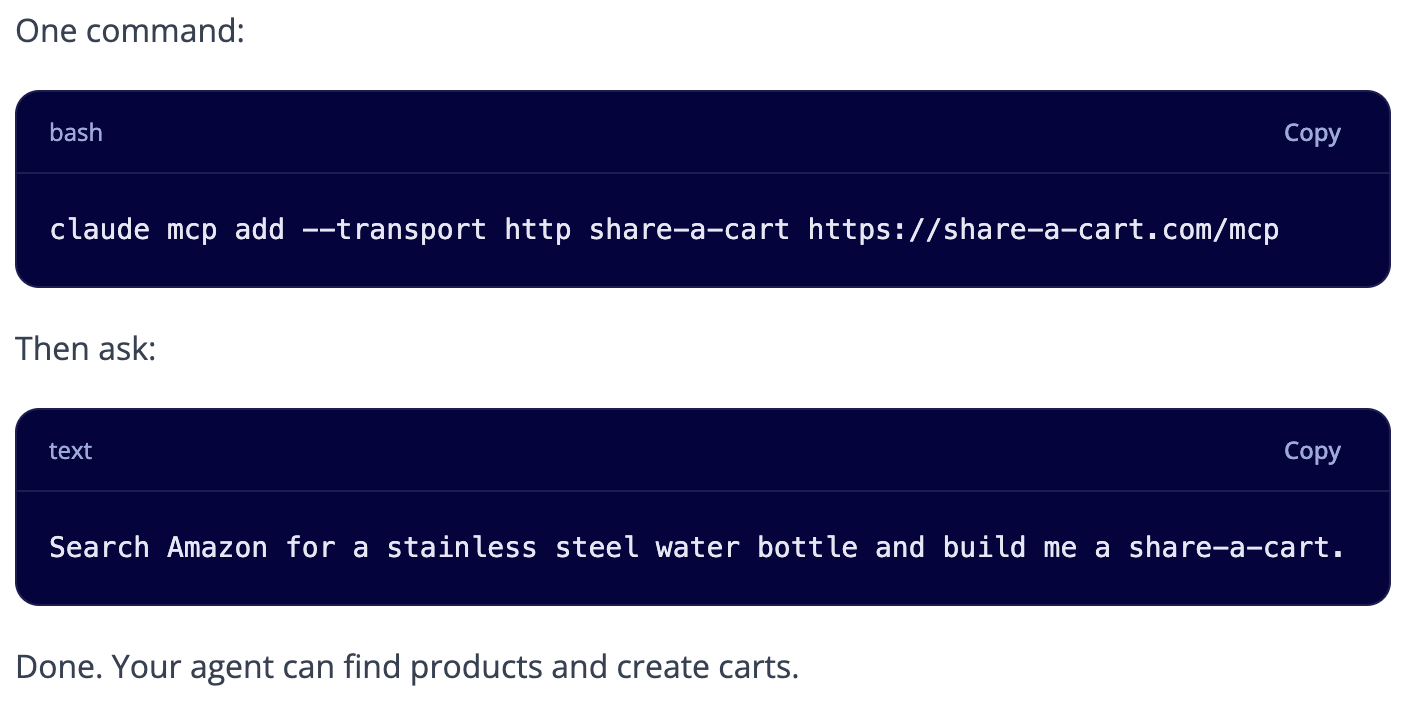
Share-A-Cart already lets anyone turn an online cart into a link they can share. Today we’re opening that same functionality up to developers: a Model Context Protocol (MCP) server that lets any AI agent — Claude, or anything else that speaks MCP — search products, build carts, and generate shareable checkout links, all through tool calls instead of scraping or reverse-engineering retailer sites.
If you’re building an AI shopping assistant, a price-comparison bot, or any agent that needs to hand a user a real, checkout-ready cart, this is the fastest way to do it.
What the server exposes
The server ships with a small set of read and write tools:
sac_search_items— search a specific retailer for products by keyword, ASIN, or product URL.sac_get_product— look up a single product’s details.sac_get_cart/sac_get_cart_view— read back an existing shared cart.sac_vendor_list— list every supported retailer, with asearchableflag telling you whether that vendor supports direct search.sac_deals— pull current Share-A-Cart promotions, by retailer or across all of them.sac_save_cart— create or update a shared cart and get back a link.sac_create_cart_from_search— go straight from a search query to a saved cart in one call.
Vendor routing: search vs. extension
Not every one of Share-A-Cart’s 200+ supported retailers has a server-side search adapter yet. Call sac_vendor_list first and check each vendor’s searchable flag: if true, you can search that retailer directly through sac_search_items. If false, direct your users to the Share-A-Cart browser extension instead, which covers the long tail of retailers a headless search can’t reach yet. Today, direct search covers Amazon, Walmart, Target, Best Buy, Kroger, eBay, and AliExpress, with more being added.
Building a cart
sac_save_cart takes an array of items, each requiring an asin (the retailer’s product identifier — ASIN, SKU, or product ID depending on vendor) plus name, img, and price whenever you have them, so the resulting shared cart is human-readable rather than a bare list of IDs. Set a top-level ccy for the cart’s currency and it’ll apply to every item unless overridden per-item. The endpoint can return HTTP 200 with an {error} field on certain failures, so check upstreamOk rather than assuming a 200 means success.
Deals, with a caveat
sac_deals surfaces live Share-A-Cart promotions per retailer or across all of them, but the upstream feed doesn’t filter out expired ones yet — check each deal’s expires_at / effective_at before surfacing it to a user. Some deals apply automatically at checkout and won’t have a code at all.
Affiliate links, same as always
Every cart the server generates resolves to a share-a-cart.com/uv/ link — the same affiliate-tracked link format that powers Share-A-Cart’s existing browser extension and website, so there’s no separate monetization model to think about for either side.
Full setup instructions, auth, and schema details live at share-a-cart.com/developers.
